
East Asian Scent Materials: What to Settle Before You Sign
A fragrance contract is signed before anyone can smell the finished product, which makes the questions asked beforehand more valuable than any later negotiation. With an East Asian palette the risk is specific: a material may be tied to one supplier, a use limit may depend on the product category, and the batch that finally arrives may differ from the reference everyone remembers. Settling four things in writing — what the fee covers, who owns the composition, how substitution works, and what evidence accompanies the goods — removes most of the arguments that would otherwise arrive months later.
Key takeaways
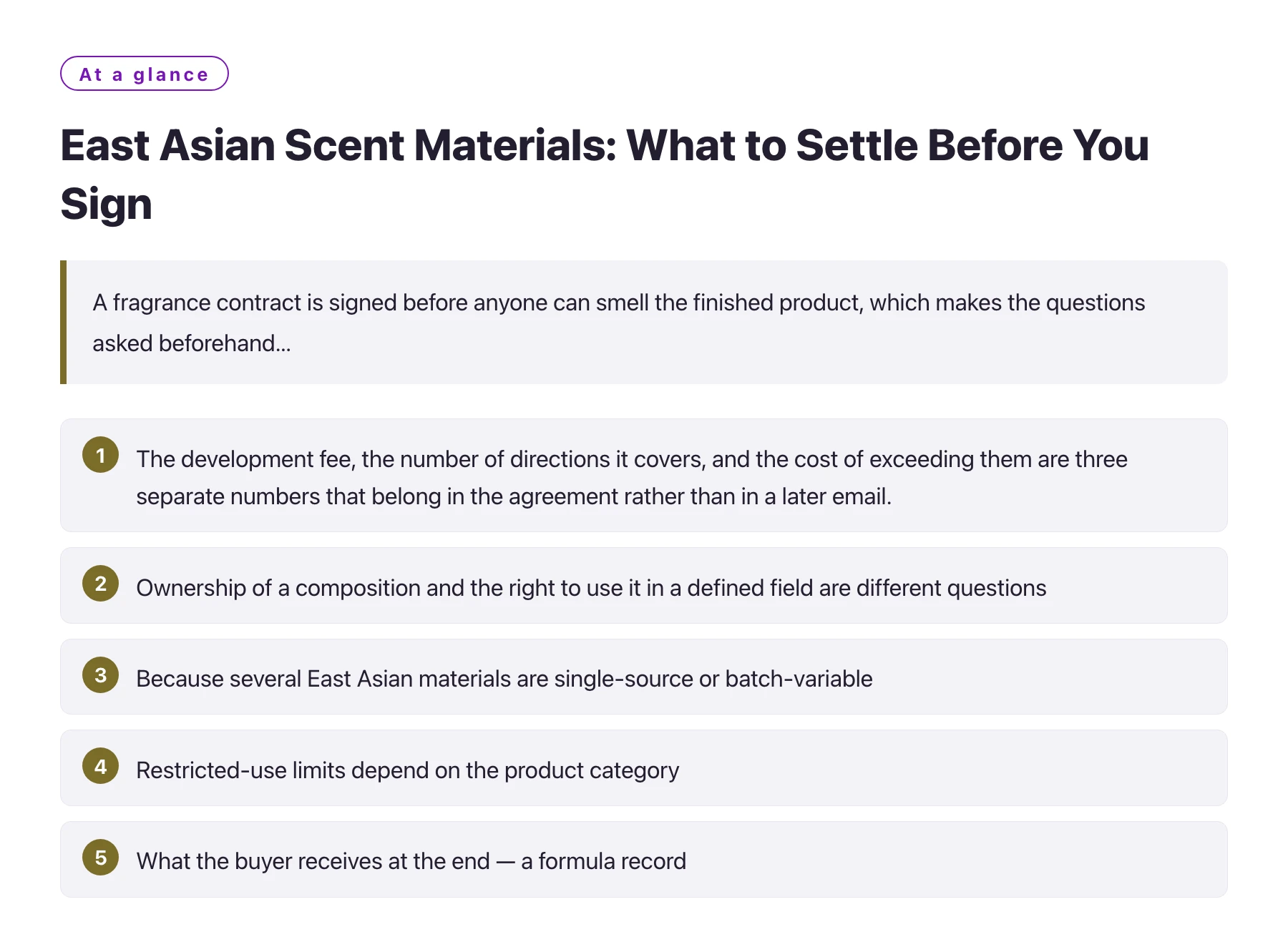
- The development fee, the number of directions it covers, and the cost of exceeding them are three separate numbers that belong in the agreement rather than in a later email.
- Ownership of a composition and the right to use it in a defined field are different questions, and paying for development does not by itself settle either one.
- Because several East Asian materials are single-source or batch-variable, the agreement needs a written substitution process with a named approver, not a verbal promise to ask first.
- Restricted-use limits depend on the product category, so the contract should state which categories the palette has been checked against and what happens if the range expands into a new one [1].
- What the buyer receives at the end — a formula record, a retained reference, test results and labelling inputs — decides whether the scent stays an asset or becomes a dependency.
Most first-time founders approach a fragrance manufacturer the way they would approach a design studio: agree the creative direction, pay for the work, approve the result. Manufacturing contracts are less forgiving than that. The product is defined by documents and decisions as much as by the scent, and the decisions that are hardest to reverse are the ones taken before any sample exists.
An East Asian palette raises the stakes because the materials themselves carry history. Some are harvested rather than synthesised, some are supplied by a small number of houses, and some sit close to a use limit in the categories a brand is likely to sell. None of that is a reason to avoid them. It is a reason to write down what happens if one of them becomes unavailable, restricted or inconsistent.
What follows is the question set worth working through before signing, organised by what each question actually protects.
The questions, grouped by what they protect
| Question | What it protects on an East Asian palette | What a clear answer names |
|---|---|---|
| How many development directions does the fee cover? | Material exploration is iterative, and a palette with several botanicals usually needs more than one interpretation before it settles | A count of directions, the price of additional rounds, and the point at which the brief is treated as closed |
| Who owns the composition, and what rights does the fee buy? | A signature accord built on distinctive materials is the part of the brand a competitor would most want to copy | The rights granted, the field and territory they cover, and what happens on termination |
| What happens if the development outcome is rejected? | Rejection after a long material search is the scenario contracts describe least clearly and projects need most often | Whether further directions are included, credited or billed, and on what timetable |
| How is a material substituted if it becomes unavailable? | Single-source absolutes and season-linked botanicals can quietly disappear from a supply plan | A named approver, a required notice period, and whether the substitution triggers a fresh sample approval |
| Which product categories has the palette been checked against? | The same accord can be comfortable in a fine fragrance and constrained in a body product or an aerosol [1] | The categories checked, the documentation produced, and the process for adding a category later |
| What testing is included, and in which combinations? | One scent across four products and two pack formats is eight combinations, not one | The combinations tested, the conditions used, who commissions the work, and who pays for repeats |
| What does the buyer receive at the end? | Deliverables decide whether the scent can be reproduced if the relationship changes | A formula record, a retained reference from the approved material, test results and labelling inputs |
| What governs the second and third order? | A launch scent is bought again for years, so reorder terms matter more than the first purchase | Minimum quantity, price validity, and what can trigger a change to either |
Eight questions look like a long list, but most of them can be answered in a single conversation; the reason to put them in writing is that development runs for months and involves several people on both sides.
The two answers that change everything
Two of these questions do more work than the rest. The first is the substitution process, because material availability is the risk that a brand cannot control and the one most often handled by reassurance. The second is the scope of the categories the palette has been checked against, because that check is cheap at the start and awkward in the middle of a launch.
Neither requires distrust. A manufacturer with a mature development process will normally have a standard answer already prepared, and the quality of that answer tells the buyer more about the partner than any presentation does. The useful comparison is not the presentation but how a factory that develops and produces the scent answers these questions before it has any reason to perform.
Substitution, written down
A workable clause is short: which materials are considered critical, who decides that a substitute is needed, how much notice the buyer gets, and whether the substitute must be approved in a fresh sample. Anything less specific tends to be resolved in the supplier's favour at the moment the buyer has least room to negotiate, which is the week before a launch.
It also helps to ask what happens to the reference sample when a substitution is made. A retained reference that is never updated tells the buyer nothing; a reference log that records each change, with dates, is what makes a reorder verifiable two years later. That level of record-keeping is normal for a factory accustomed to producing for brands that audit their supply chain, and it is a fair question to put to the perfume factory in Guangzhou or to any partner being considered.
Category scope and the expanding range
Brands rarely launch one product. A scent that begins as a fine fragrance tends to acquire a body lotion, a hair mist or a home product within a season, and each addition is a new category with its own limits. Asking at the contract stage which categories have been assessed, and what the process is for adding another, avoids the situation where a successful first product cannot be extended without reworking the accord.
If the answer is that only the launch category has been checked, that is not a problem — it is information, and it can be priced and scheduled. The difficulty only arises when the limitation surfaces after the range has been sold in.
If the negotiation has to be compressed, protect three clauses and accept standard terms elsewhere: what the development fee covers and what exceeding it costs, the rights the brand receives over the composition, and the substitution process. Everything else, including payment staging and delivery terms, is comparatively easy to adjust later. A partner that treats the work as a defined development programme will usually have clean answers to all three before being asked — the kind of partner worth a short due diligence pass on due diligence on a perfume manufacturer before any signature.
Sources
- IFRA Standards Library (International Fragrance Association) —— The IFRA Standards Library lists the restrictions the fragrance industry applies to individual fragrance ingredients, based on safety assessments; it is the reference point for compliant fragrance formulation.
Frequently asked questions
Does paying a development fee mean the brand owns the formula?
Not automatically. Many manufacturers keep ownership of the composition and grant the buyer rights to use it in a defined field, which may be exclusive or non-exclusive. Both structures are common and workable; the important point is that the arrangement is written down rather than inferred from the fact that a fee was paid.
How many development directions should a first project include?
Enough to explore more than one reading of the brief, and not so many that selection becomes unwieldy. The count matters less than the terms attached to it: what happens when the directions are exhausted, whether extra rounds are credited against a later order, and when the brief is treated as fixed.
Should an East Asian palette be checked for restricted materials before signing?
Yes, or at the very least the contract should state which categories have been assessed. Use limits are set per category, so the check is specific to the products being launched and does not transfer automatically when the range expands into a new format.
What if a material in the approved accord becomes unavailable?
That is why the substitution process belongs in the agreement. A written clause naming the critical materials, the notice period, the approver and whether a new sample approval is required converts a supply surprise into a routine change instead of a development restart.
What should the brand receive when development ends?
A formula record, a sealed retained reference from the approved material, the test results commissioned during development, and the labelling inputs derived from the composition. Together these make the scent reproducible, which is what turns a development project into something the brand actually holds.
Plan Your Launch
Have a product that deserves a better digital flagship?
Twenty minutes with a senior interactive director. We come prepared with a 3D approach sketch and a 6-week scope.