
Why is a horizontal machining center ideal for automotive and aerospace components?
A horizontal machining center leverages gravitational force to evacuate chips from complex geometries, a requirement for machining aerospace titanium and automotive aluminum alloys. By employing automatic pallet changers, these machines achieve spindle utilization rates exceeding 85% in high-volume environments, compared to 40% for manual setups. The rigid box-way construction dampens vibration during heavy-duty milling, sustaining tolerances within $\pm 5 \mu m$. Aerospace structural components and engine blocks benefit from multi-axis indexing, reducing setup transfers by 60% compared to 3-axis alternatives. This configuration maximizes throughput for parts demanding high-volume production and complex tolerances.
Gravity assists in clearing debris during high-speed milling operations within the work envelope. In this horizontal setup, chips fall away from the cutting zone, which prevents the re-cutting of metal particles.
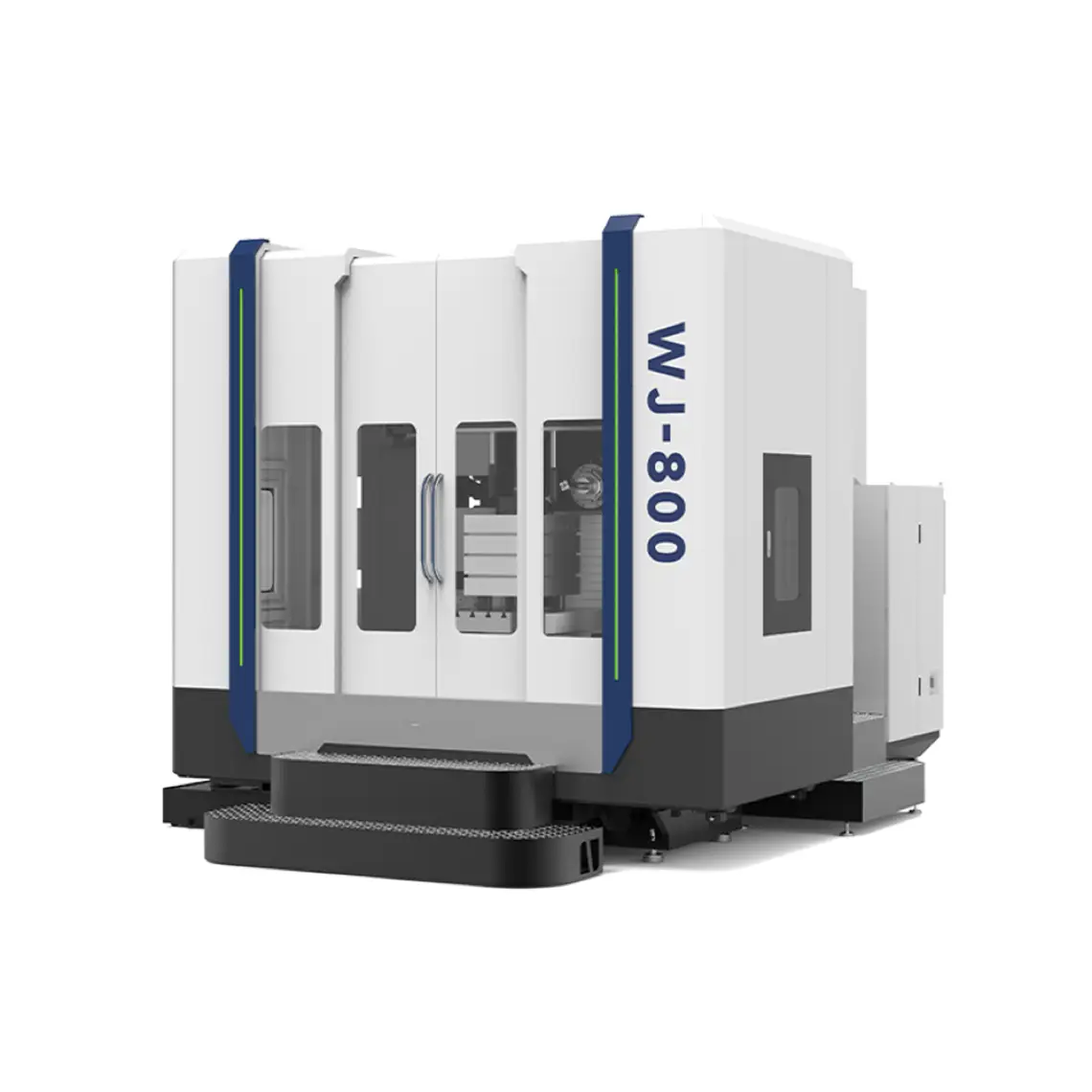
Studies from 2023 indicate that tool life increases by 25% when chips are evacuated effectively. This debris management prevents particles from scratching the surface of aerospace grade Aluminum 7075-T6 during finishing passes.
Effective cleaning allows manufacturers to switch parts rapidly between different stages of a production run. Automatic pallet changers facilitate this transition by keeping the spindle active during the loading phase.
Standard pallet exchange times average 12 seconds for modern HMC units. This rapid interchange ensures spindle utilization remains consistently above 85% in automotive powertrain facilities.
In high-production environments, every second of non-cutting time reduces the return on investment. Automated pallet systems allow concurrent part setup, reducing idle time by 40% across a standard shift.
High utilization demands a machine structure that absorbs heavy cutting forces without deflection. The mechanical design focuses on mass distribution to minimize vibration throughout the frame.
Cutting Inconel 718 produces significant torque loads on the machine spindle. Systems using heavy-duty box-way designs often show 30% less vibration amplitude compared to lighter linear guide systems during roughing passes.
Maintaining vibration control allows for tighter geometric tolerances on complex parts. Indexing tables enable 4th and 5th axis capabilities without manual operator intervention between machining faces.
| Feature | Tolerance Capability | Application |
| B-axis Indexing | $\pm 0.001$ degrees | Turbine Blade Root |
| Linear Accuracy | $\pm 0.005$ mm | Cylinder Block Boring |
High-precision indexing requires consistent temperature control to maintain consistent dimensions. High-pressure through-spindle coolant delivers fluids at rates exceeding 70 bar directly to the tool tip.
This high-pressure delivery flushes heat from deep-hole drilling operations in transmission housings. Maintaining thermal stability keeps part variance under 10 microns across an 8-hour production shift.
Thermal management often requires complex chillers integrated into the machine base. These chillers regulate spindle temperature, ensuring a variance of less than 0.5°C during continuous operation.
Many automotive manufacturers implemented this thermal monitoring in 2024 to reduce scrap rates. Reported scrap rates dropped from 3% to 0.5% after the integration of thermal compensation software.
Lower scrap rates rely on high-torque spindle motors to maintain cutting force. Spindle power often exceeds 30 kW to maintain consistent chip loads across difficult-to-cut materials like hardened steel.
These performance specifications accommodate diverse part geometries encountered in modern engineering. Operators can switch between aluminum engine blocks and steel transmission cases with minimal reprogramming time.
Minimal reprogramming stems from advanced CNC controllers capable of high-speed look-ahead processing. These controllers process over 1,000 blocks of G-code per second to ensure smooth, continuous motion.
Smooth motion prevents surface finish degradation on sealing surfaces. Aerospace structural components often require surface roughness values (Ra) below 0.8 micrometers, which this motion control achieves.
Achieving such fine surface finishes requires stable foundation requirements for the machine tool. Standard specifications recommend a reinforced concrete pad at least 300 mm thick to maintain bed alignment.
Alignment protocols involve laser calibration techniques repeated annually. A deviation of more than 10 microns over the full X-axis travel usually triggers a recalibration cycle to restore factory accuracy.
Recalibration ensures that the machine remains within the tolerances required for automotive transmission gear housings. These housings contain bore patterns where positioning accuracy determines the longevity of the gears.
Engineers select these horizontal platforms because they balance heavy-duty cutting capacity with fine precision. The ability to mount multiple workpieces on a single tombstone fixture further multiplies output per square meter.
Each tombstone fixture can hold up to 4 distinct parts simultaneously. This increases the total number of parts produced per spindle hour by a factor of 3 when compared to single-part setups.
This increased capacity supports the JIT (Just-In-Time) manufacturing requirements common in the global automotive sector. Suppliers maintain inventory levels by adjusting production cycles based on real-time order fluctuations.
Production data logs from 2025 show that machine uptime is the primary driver of manufacturing profitability. Higher availability allows for shorter cycle times, meeting delivery windows for aerospace tier-one suppliers.
Data from these systems helps operators refine feed rates and spindle speeds. Optimizing these parameters improves the material removal rate (MRR) by an average of 15% without increasing tool wear.
Improving MRR reduces the total energy consumed per part manufactured. Efficient machines utilize regenerative braking on the Z-axis motors to feed power back into the facility grid during deceleration.
Energy efficiency metrics influence the selection of equipment in modern manufacturing plants. Companies prioritize machines that demonstrate lower power consumption per cubic centimeter of material removed.
Lower power draw aligns with corporate sustainability targets established in the early 2020s. Monitoring energy usage allows facilities to shift heavy machining loads to off-peak hours, reducing operational costs.
Cost reductions remain the focus for large-scale production facilities. Managing the lifecycle of the machine tool, including maintenance schedules and software updates, ensures the long-term reliability of the production line.
Plan Your Launch
Have a product that deserves a better digital flagship?
Twenty minutes with a senior interactive director. We come prepared with a 3D approach sketch and a 6-week scope.