
Custom Jewelry Wholesale MOQ by Base Material
Three numbers govern a custom jewelry wholesale order: 50 pieces per design in 925 sterling silver, 100 in artisan eco-brass and 100+ in stainless steel. The spread follows the metal and the finishing route behind each one, and it decides how a range is split long before a mould is cut. A buyer who reads the minimums as a ladder rather than a hurdle can plan a launch around them instead of tripping over them.
Key takeaways
- MOQ is counted per design, per metal and per finish, so five designs mean five separate minimums rather than one pooled total.
- Silver's 50-piece minimum is 50% of the brass figure, which changes the arithmetic of a test run more than it changes the metal cost.
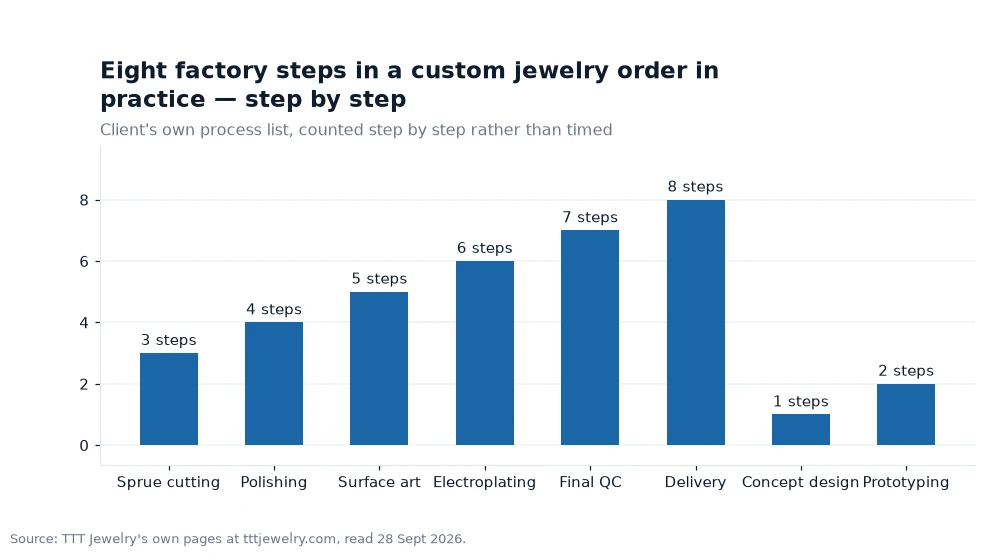
- Every design passes the same eight factory steps, so a small run carries the same number of process handoffs as a large one.
- Sampling takes 25–30 days and bulk production 3–4 weeks, giving a 48–60 day path from CAD brief to dispatch.
The three published minimums, and what per design means
The published figures are specific. 925 sterling silver carries a minimum of 50 pieces per design. Artisan eco-brass carries 100 pieces per design. Stainless steel carries 100+ pieces per design. The words per design do the heavy lifting in all three: the minimum attaches to a single design in a single metal, not to the purchase order as a whole.
That distinction catches first-time buyers. An order for five silver designs is not a 50-piece order; it is five runs of 50, or 250 pieces. An order for three brass designs and two silver designs is five runs at two different thresholds. The same logic applies to finishes: one design produced in 14K gold and again in rhodium is two plating batches and two sets of fixed work, even though the casting is shared. Planning starts by counting designs, metals and finishes, not pieces.
Why silver starts at half the brass figure
Silver sits at 50 while brass sits at 100, a ratio of 50/100, or 50%. The gap reflects what each line has to absorb before a piece is saleable. Brass work tends to lean on surface treatment — high-gloss polishing, brushed and textured effects, then multi-layer plating — and each of those stages wants a batch large enough to run evenly. Silver is quoted at a lower entry point, which is useful for a brand testing a higher-priced tier without committing to a hundred units of an unproven shape; the sterling silver jewelry manufacturer page covers that 925 route in detail.
Stainless steel is quoted at 100+ rather than a flat number, which signals that the threshold moves with the design. PVD vacuum plating runs in a chamber, and chamber loads shape how a batch is built. For a waterproof line aimed at daily wear, the 100+ entry buys a plating batch that is worth scheduling.
| Order shape | Minimum per design | What the minimum has to cover |
|---|---|---|
| 925 sterling silver | 50 pieces | Casting, stone setting, polishing, multi-layer plating, anti-tarnish e-coating |
| Artisan eco-brass | 100 pieces | Casting, high-gloss polish, surface art, multi-layer plating |
| Stainless steel | 100+ pieces | PVD vacuum plating and the finishing that precedes it |
| One design in two metals | 50 plus 100, so 150 for silver and brass | Two masters, two plating routes; the thresholds do not pool |
| One design in two colourways | Two runs at the metal minimum | Two plating batches on one casting |
Eight steps, repeated for every design
Every order moves through the same eight factory steps: concept design in hand drawing and CAD, prototyping by mould or 3D printing, sprue cutting, high-gloss polishing, brushed and textured surface art, electroplating, 100% final QC and delivery. The sequence does not get shorter for a small run. Four designs therefore create 4 × 8 = 32 process handoffs, where one design creates eight.
That is the real reason a minimum exists. The factory is not protecting a price; it is making sure the fixed portion of those eight steps is spread across enough pieces to be worth scheduling. The full sequence, and the wholesale terms that sit around it, is laid out at www.tttjewelry.com/custom-jewelry-wholesale/, including the six customisation options that can add a step of their own.
Splitting a range without multiplying setup
A six-design launch in two metals is a common shape: four silver designs at 50 pieces each gives 200 pieces, and two brass designs at 100 each gives another 200, for 400 in total. The order carries six moulds, six samples and 48 step handoffs. Cutting the range to three designs and restocking later would halve the fixed work at the cost of a second production window of 3–4 weeks.
There is a middle route. Launch two designs deep enough to sell through, keep the other four as CAD-approved samples, and add them to the next production run once sell-through data exists. The samples are already approved at 25–30 days, so the second run skips straight to bulk. What the buyer pays for is the discipline of holding a design back rather than the discount of a smaller order.
Shared components do not pool the minimum, but they do reduce avoidable extra work. One chain style across four pendants, one clasp across three bracelets and one backing card across the whole range each mean fewer distinct purchase lines, even though each design still needs its own casting and plating batch. When a range is being trimmed to fit the thresholds, trim the components first: it costs nothing in design and saves a set of small, repeated orders.
Worked example
A brand plans six designs: four in 925 sterling silver at 50 pieces and two in artisan eco-brass at 100. Silver volume is 4 × 50 = 200 pieces; brass volume is 2 × 100 = 200; the order totals 400 pieces. Fixed work is paid six times — six CAD files at under 48 hours each, six masters, six samples — and the eight-step sequence is walked 6 × 8 = 48 times across the range. If the same 400 pieces were ordered as eight designs of 50, every design would sit at the silver threshold, but the fixed work would rise from six sets to eight, a 33% increase in setups for the same piece count. Sampling at 25–30 days can run in parallel across the six designs, so the calendar stays at roughly 25–30 days plus 21–28 days of production: 48–60 days to dispatch, or 7–9 weeks.
Frequently asked questions
Is the minimum per design or per order?
Per design, and per metal. Each design in each metal is its own run with its own mould, sample and plating batch. Ten designs at the silver threshold are ten runs of 50 pieces, not one run of 500, even when they ship together.
Can a single order mix silver, brass and stainless steel?
Yes, but each material keeps its own threshold and its own finishing route. A mixed order is priced and scheduled as several runs that share a delivery date. The buyer gains one shipment, not one minimum.
Does a lower minimum mean a slower delivery?
Not directly. The calendar is driven by sampling at 25–30 days and production at 3–4 weeks, not by piece count. A 50-piece silver run and a 100-piece brass run both pass through the same eight steps, so the schedule is set by approvals rather than volume.
Choosing the metal before the design
Metal choice sets the minimum, the finishing route and the price tier, so it belongs at the start of a collection plan rather than at the end. A brand testing a premium tier can open with silver at 50 pieces; a volume line fits stainless at 100+; brass sits between them at 100 with the widest surface treatment options. The custom brass jewelry range shows how much of the look comes from polish and plating rather than the alloy itself. Build the range around the thresholds and each design arrives with a batch size that justifies its setup.
Source note: figures come from the manufacturer's own website (tttjewelry.com), read 28 Sept 2026.[1]